
What Is the IVF Process and What Happens at Each Step?

iKey Takeaways
- ✓IVF allows fertilization to take place outside the body in a controlled laboratory setting.
- ✓A typical cycle involves ovarian stimulation, egg retrieval, fertilization, embryo development, and embryo transfer.
- ✓Not every retrieved egg will fertilize, and not every embryo will continue developing.
- ✓IVF does not guarantee pregnancy, and success depends on several individual factors.
- ✓A fertility specialist in Kanpur can help determine whether IVF or another fertility treatment is appropriate for you.
- ✓Early evaluation can be particularly important when there are known fertility problems or difficulty conceiving.
Quick Answer
In Vitro Fertilization (IVF) is a fertility treatment in which an egg and sperm are brought together in a laboratory to create an embryo. If a suitable embryo develops, it may be transferred into the uterus with the aim of achieving pregnancy.
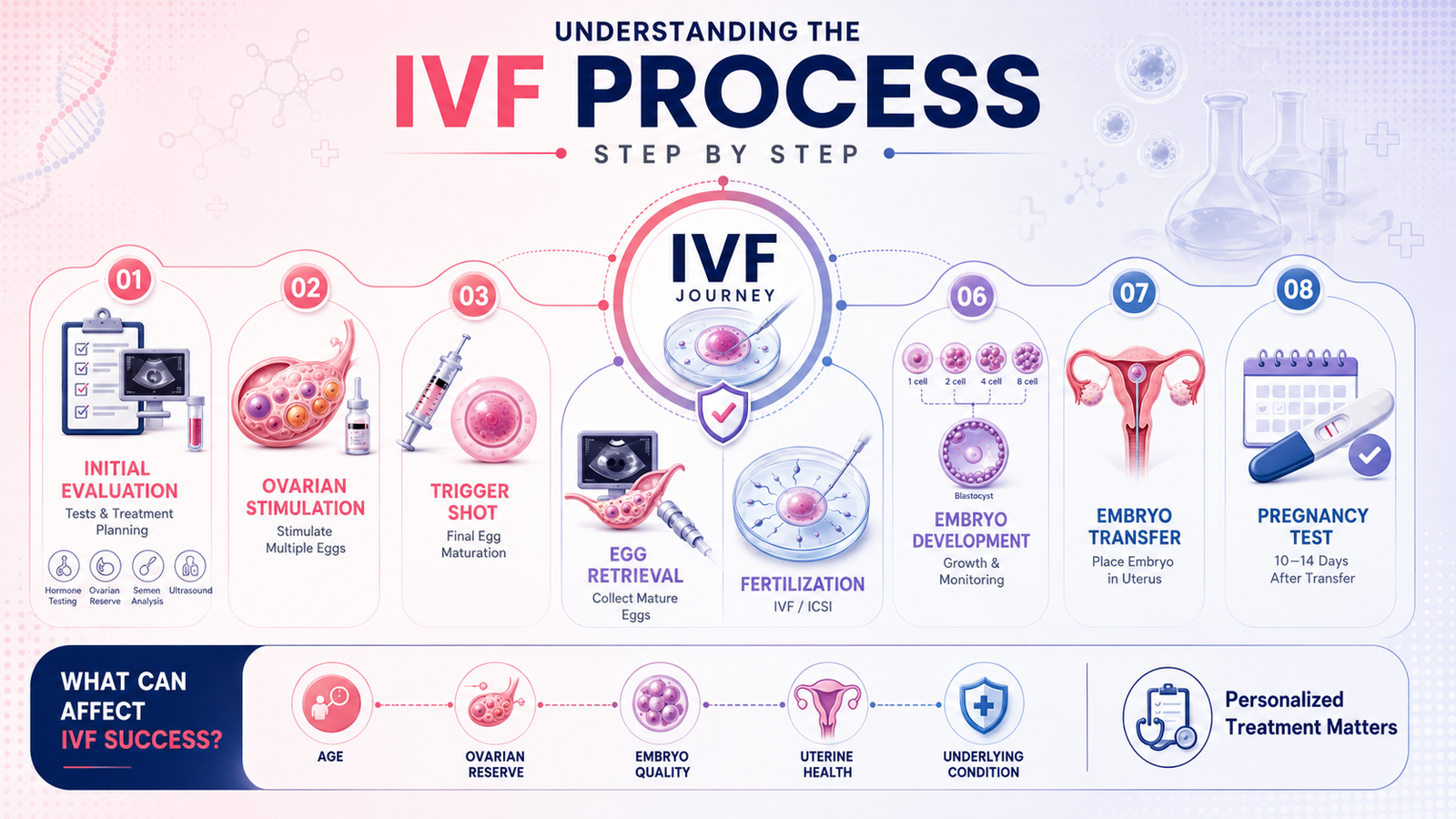
An IVF cycle usually involves fertility evaluation, ovarian stimulation, trigger injection, egg retrieval, fertilization, embryo development, embryo transfer, and pregnancy testing.
The exact IVF plan is different for every woman or couple. Your age, ovarian reserve, sperm health, previous fertility history, medical conditions, and response to treatment can all influence the treatment approach.
What Is IVF and How Does It Work?
IVF is an assisted reproductive technology (ART) in which eggs are collected from the ovaries and fertilized with sperm in a laboratory. The resulting embryo may then be transferred into the uterus.
Unlike natural conception, where fertilization usually occurs inside the fallopian tube, IVF moves the fertilization process into the laboratory.
IVF may be considered when pregnancy has been difficult to achieve because of factors such as:
- Blocked or damaged fallopian tubes
- Certain ovulation problems
- Reduced ovarian reserve
- Endometriosis
- Some forms of male-factor infertility
- Unexplained infertility
- Previous fertility treatment that has not resulted in pregnancy
IVF is not automatically the first fertility treatment for everyone. A fertility evaluation helps determine which treatment is most appropriate for your situation.
What Happens Before Starting an IVF Cycle?
Before IVF begins, both partners are generally evaluated so the fertility team can understand the possible cause of infertility and plan treatment.
For the woman, assessment may include:
- Medical and menstrual history
- Hormonal blood tests when indicated
- Ovarian reserve assessment
- Pelvic ultrasound
- Evaluation of the uterus and ovaries
- Additional tests based on the individual's history
For the male partner, semen analysis is commonly performed to assess sperm concentration, movement, and morphology.
The findings help the fertility specialist decide whether IVF is appropriate and whether additional procedures or medications may be needed.
What Are the Main Steps of IVF?
An IVF cycle follows several carefully timed stages. However, the exact medications, monitoring schedule, and timing can vary from person to person.
Step 1: How Does Ovarian Stimulation Work?
Ovarian stimulation uses fertility medications to encourage the ovaries to develop multiple follicles rather than the single dominant follicle usually produced during a natural cycle.
The medication schedule commonly lasts around 8–14 days, although the duration can vary.
During stimulation, your doctor monitors follicle development using:
- Transvaginal ultrasound
- Blood tests when required
- Changes in hormone levels
- Clinical response to medication
The goal is not simply to produce as many eggs as possible. The treatment needs to be adjusted according to your individual response while maintaining safety.
What Might You Feel During Stimulation?
Some women experience:
- Abdominal fullness or bloating
- Mild pelvic discomfort
- Breast tenderness
- Mood changes
- Injection-site discomfort
Your fertility team will explain which symptoms are expected and which require medical attention.
Step 2: What Is the IVF Trigger Injection?
The trigger injection helps complete the final maturation process of the eggs and allows the fertility team to carefully schedule egg retrieval.
The timing of this injection is important because egg retrieval is planned according to the expected maturation of the follicles.
Your doctor will tell you exactly when to administer the trigger medication. It is important not to change the timing without speaking with your fertility team.
Step 3: How Are Eggs Retrieved During IVF?
Egg retrieval is a short procedure in which mature eggs are collected from the ovarian follicles using ultrasound guidance.
The procedure is generally performed approximately 34–36 hours after the trigger injection, depending on the treatment protocol.
A fine needle is guided through the vaginal wall toward the ovaries to aspirate fluid from the follicles. The laboratory team then examines the collected fluid for eggs.
Sedation or anesthesia may be used depending on the clinic and individual circumstances.
After retrieval, mild cramping, pelvic discomfort, or bloating can occur.
Step 4: How Are the Eggs Fertilized?
After egg retrieval, the collected eggs are taken to the embryology laboratory, where they are fertilized using sperm.
There are two commonly used fertilization approaches:
| Method | How does it work? | When may it be considered? |
|---|---|---|
| Conventional IVF | Eggs and prepared sperm are placed together in the laboratory to allow fertilization to occur. | When sperm parameters and other factors are considered suitable |
| ICSI | A single sperm is injected directly into a mature egg. | May be considered in certain cases of male-factor infertility or previous fertilization problems |
The choice between conventional IVF and ICSI depends on the clinical situation and laboratory considerations. ICSI is not automatically necessary for every IVF cycle.
Step 5: What Happens to the Embryos After Fertilization?
After fertilization, embryos are monitored in the laboratory as they continue developing over the following several days.
Not every egg retrieved will fertilize. Similarly, not every fertilized egg will continue developing into an embryo suitable for transfer or freezing.
This reduction in numbers during the process is expected and is one reason fertility specialists consider the entire treatment journey rather than focusing only on the number of eggs retrieved.
The embryology team assesses embryo development and discusses the available options with the treating doctor.
Step 6: What Happens During Embryo Transfer?
Embryo transfer involves placing a selected embryo into the uterus using a thin catheter passed through the cervix.
The procedure is usually brief and does not generally require anesthesia.
The embryo is placed inside the uterine cavity with the aim of allowing implantation to occur naturally afterward.
Depending on the treatment plan, embryos that are suitable for freezing may be cryopreserved for future treatment.
A frozen embryo transfer may be planned later rather than transferring an embryo during the same stimulation cycle.
Step 7: When Is the Pregnancy Test Done After IVF?
A pregnancy test is performed after embryo transfer to determine whether pregnancy has occurred.
Your fertility team will provide the appropriate testing date. A Beta-hCG blood test is commonly used because it can detect pregnancy more reliably than testing too early at home.
The waiting period between embryo transfer and pregnancy testing can be emotionally difficult. Try to follow your clinic's medication instructions and avoid interpreting individual symptoms as proof of pregnancy or treatment failure.
How Long Does the IVF Process Take?
The active part of an IVF cycle can take approximately two to three weeks, but the total treatment timeline can be longer.
The timeline depends on the treatment protocol and whether additional steps are required.
For example:
Fertility assessment → ovarian stimulation → trigger → egg retrieval → fertilization → embryo development → embryo transfer → pregnancy test
If embryos are frozen, genetic testing is performed, or a frozen embryo transfer (FET) is planned, treatment may extend over a longer period.
Your fertility specialist can give you a more specific timeline after reviewing your investigations.
What Determines IVF Success?
IVF success depends on several biological and treatment-related factors, and no fertility clinic can guarantee a pregnancy from an individual IVF cycle.
Important factors can include:
- Age
- Egg quality
- Ovarian reserve
- Sperm quality
- Cause and duration of infertility
- Embryo development
- Uterine and endometrial factors
- Previous fertility treatment
- Individual medical history
Age is particularly important because egg quality generally changes with increasing age.
This is why published IVF success rates should not be interpreted as a personal prediction. Your own fertility assessment provides much more meaningful information.
What Are the Risks and Warning Signs During IVF?
IVF is generally considered a well-established fertility treatment, but medications and procedures can have risks.
One important complication associated with ovarian stimulation is ovarian hyperstimulation syndrome (OHSS). It occurs when the ovaries respond excessively to fertility medication.
Symptoms can range from mild bloating and abdominal discomfort to more serious complications.
Is IVF Painful?
Most people experience some discomfort during IVF, but the level of discomfort varies considerably.
The injections may cause temporary stinging or soreness. Ovarian stimulation can also produce bloating or pelvic heaviness.
Egg retrieval is performed with appropriate pain relief or sedation according to the treatment setting.
Embryo transfer is generally a much simpler procedure and may feel similar to other procedures involving passage of a thin catheter through the cervix.
If you are worried about pain, discuss your concerns with your fertility team before treatment begins.
How Many Embryos Are Transferred During IVF?
The number of embryos transferred is individualized and depends on factors such as age, embryo characteristics, previous treatment history, and clinical circumstances.
In many situations, transferring a single suitable embryo can reduce the risk of a multiple pregnancy.
The goal of IVF is not simply to transfer more embryos. It is to achieve the best possible chance of a healthy pregnancy while minimizing avoidable risks.
Your fertility specialist can explain why a particular number is recommended for you.
What Happens If IVF Does Not Result in Pregnancy?
An unsuccessful IVF cycle does not necessarily mean that pregnancy is impossible.
After a cycle, your fertility team may review:
- Ovarian response
- Number of eggs retrieved
- Fertilization results
- Embryo development
- Embryo transfer details
- Hormonal or uterine factors
- Previous treatment history
Depending on these findings, the next plan may involve modifying medications, changing the treatment approach, using frozen embryos if available, or investigating other factors.
There is no single explanation for every unsuccessful IVF cycle, so the next step should be based on your individual clinical information.
When Should You See a Fertility Specialist?
You should consider a fertility evaluation if you have been trying to conceive without success or if you already have a condition that may affect fertility.
Evaluation may be appropriate sooner when there is a history of:
- Irregular or absent periods
- Known PCOS or significant ovulation problems
- Endometriosis
- Previous pelvic or tubal problems
- Recurrent pregnancy loss
- Known male-factor fertility problems
- Previous fertility treatment
- Reduced ovarian reserve
If you are searching for a fertility specialist in Kanpur, an individualized consultation can help determine whether IVF is appropriate or whether another treatment option should be considered first.
Can PCOS or PCOD Affect Fertility?
PCOS can affect ovulation and may make conception more difficult for some women, but having PCOS does not mean that pregnancy is impossible.
Treatment depends on whether the main issue is irregular ovulation, another fertility factor, or a combination of factors affecting both partners.
If you are looking for a PCOD doctor or a PCOS clinic, a proper evaluation can help identify the cause of irregular ovulation and determine the appropriate fertility treatment.
Importantly, IVF is not automatically required simply because someone has PCOS.
How Can a Gynecologist Help With Fertility Problems?
A gynecologist can assess menstrual, hormonal, reproductive, and gynecological factors that may be affecting conception and refer or coordinate fertility treatment when appropriate.
A Gynecology Consultation in Kanpur may include discussion of:
- Menstrual cycle patterns
- Previous pregnancies
- Duration of trying to conceive
- Previous treatments
- Medical and surgical history
- Pelvic symptoms
- Initial fertility investigations
Women who are looking for a lady gynecologist in Kanpur, gynecologist near me, or a pregnancy specialist may benefit from choosing a doctor who takes time to understand their complete reproductive history rather than focusing on a single test.
Doctor's Note
IVF should be approached as an individualized treatment process rather than a fixed sequence that is identical for every couple. Your response to medication, egg numbers, fertilization results, embryo development, and other clinical findings can all influence decisions during treatment.
A detailed fertility assessment before starting IVF helps your doctor understand which treatment approach is most appropriate for your circumstances.
Start Your Fertility Journey in Kanpur
If you are considering IVF, the first step is not necessarily starting injections. It is understanding why conception has been difficult and what treatment options are appropriate for you.
At Medfemme Women's Clinic in Kanpur, Dr. Priyanka Bhargava provides gynecological and reproductive care with an individualized approach to women's health and fertility concerns.
If you are searching for a fertility specialist in Kanpur, best gynecologist in Kanpur, Top Gynecologist in Kanpur, or a pregnancy specialist, a consultation can help you understand your options based on your medical history and investigations.
Book a consultation to discuss your fertility concerns and understand whether IVF or another treatment approach may be suitable for you.
Final Takeaway
IVF is a carefully monitored fertility treatment involving several stages—from ovarian stimulation and egg retrieval to fertilization, embryo development, transfer, and pregnancy testing.
The process can feel complicated, but understanding what happens at each stage can make treatment easier to navigate.
Most importantly, IVF should be personalized to your age, ovarian reserve, sperm factors, reproductive history, and overall health. A fertility evaluation is the best starting point for understanding your individual options.
Medical Review
Medically reviewed by Dr. Priyanka Bhargava, Medfemme Women's Clinic, Kanpur.
Medical Disclaimer
This article is intended for general educational purposes only and does not replace individual medical consultation, diagnosis, or treatment. Fertility treatment, including IVF, should be planned with a qualified fertility specialist after appropriate evaluation of both partners.
When Should You Contact Your Fertility Clinic?
Seek prompt medical advice if you develop symptoms such as severe or increasing abdominal pain, significant abdominal swelling, rapid or unexpected weight gain, persistent vomiting, difficulty breathing, reduced urine output, or feeling unusually unwell during an IVF cycle.
Frequently Asked Questions
How many days does an IVF cycle take?
The active stimulation and egg-retrieval portion of IVF often takes around two to three weeks. The overall timeline may be longer when preparation, embryo freezing, genetic testing, or frozen embryo transfer is involved.
Is IVF painful?
IVF can cause temporary discomfort from injections, ovarian stimulation, and egg retrieval. Pain relief or sedation is generally used for egg retrieval, while embryo transfer is usually a brief procedure.
How many eggs are needed for IVF?
There is no single ideal number of eggs for every woman. The response to stimulation varies according to age, ovarian reserve, medication response, and other factors. More eggs do not automatically guarantee a successful pregnancy.
What is the difference between IVF and ICSI?
In conventional IVF, prepared sperm and eggs are placed together so fertilization can occur. In ICSI, an embryologist injects a single sperm directly into a mature egg. ICSI may be useful in selected situations, particularly certain cases involving sperm-related fertility problems.
When is IVF recommended?
IVF may be considered for several fertility problems, including tubal-factor infertility, some forms of male-factor infertility, endometriosis, certain ovulation problems, unexplained infertility, or when other fertility treatments have not been successful.
Can I get pregnant after one IVF cycle?
Yes, pregnancy can occur after a single IVF cycle, but it is not guaranteed. The likelihood varies considerably between individuals and depends on factors such as age, egg and sperm factors, embryo development, and the underlying cause of infertility.
What happens after a failed IVF cycle?
Your fertility specialist will usually review the results of the cycle to identify factors that may influence the next treatment plan. Depending on the findings, medications or other aspects of treatment may be adjusted.
Should I consult a fertility specialist before trying IVF?
Yes. A fertility consultation can help determine whether IVF is appropriate and whether there are other treatments or investigations that should be considered first.